Arrow Jam
Tap each arrow in the right order to clear the board: 1,000 generated and audited levels, from two arrows to boards of more than 300.
- Role
- Co-Founder
- Studio
- Vel Nest Games
- Platforms
- Android, Meta Quest
- Built with
- Unity, C#, UI Toolkit, OpenXR
- Levels
- 1,000, then endless
By the numbers
Clear the board in the right order
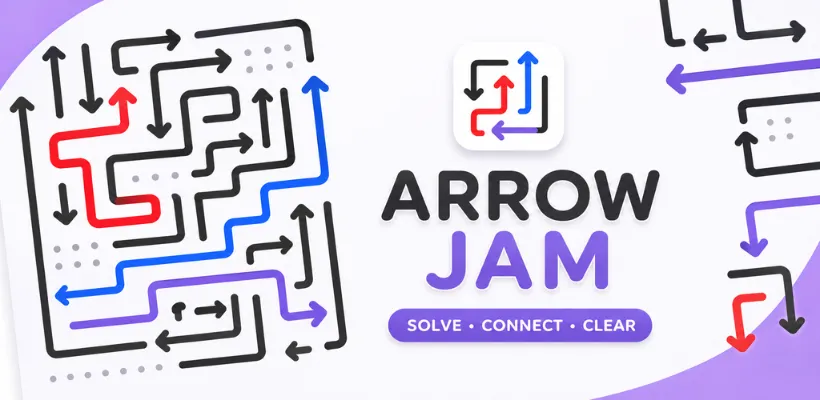
Arrow Jam is a tap-away logic puzzle. The board is packed with arrows that together form a shape, like a heart, a fish or a plain square. Tap an arrow, and if the straight line from its head to the edge is clear, it slides off the board. If another arrow is in the way, it bumps into it, comes back red and costs one of your three hearts.
Every arrow you clear opens a path for others, so the whole game is finding the right order. Tapping the same red arrow again never costs a second heart. Arrow Jam is free on Google Play, and the Meta Quest edition is paid and ad-free, with the same board floating in front of you.
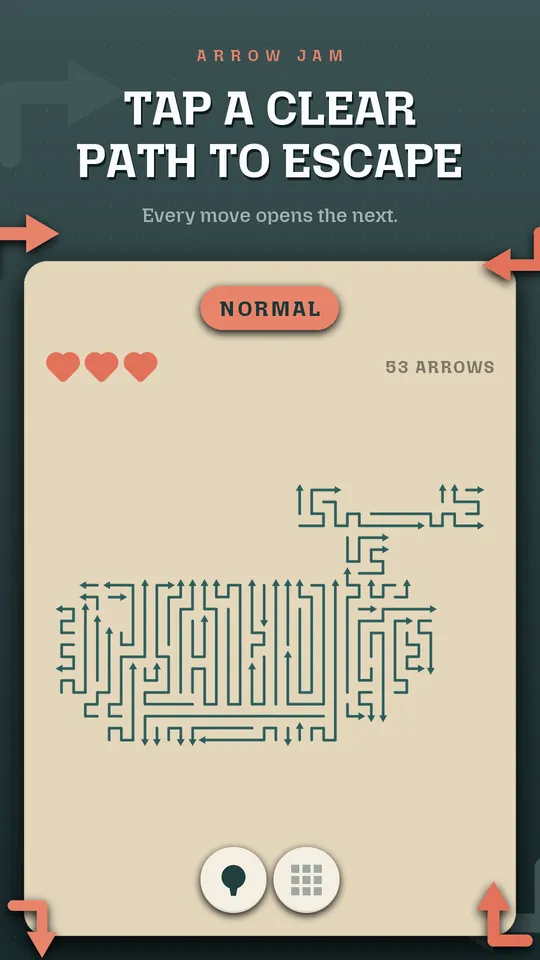
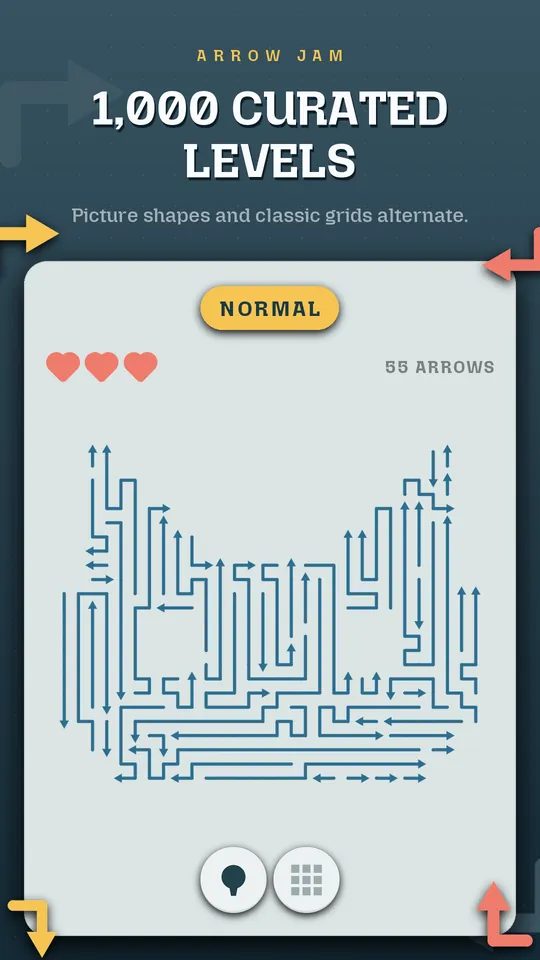
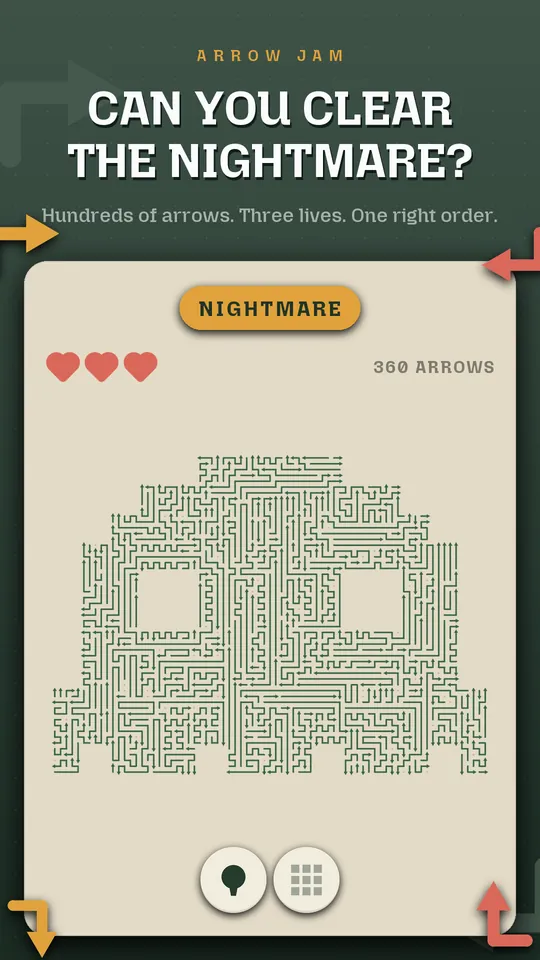
Levels built backwards
The level builder never has to search for a solution. It places arrows one at a time into the free cells of a shape and keeps an arrow only if the path from its head is clear. Removing the arrows in reverse order is then always a solution. To make a level hard, a new arrow often starts on the exit path of the one before it, which builds long chains of arrows that lock each other.
Each level is built from up to eight seeds. The closest fit is kept together with its seed, so every level can be rebuilt exactly. A separate solver must clear every level. A level is also rejected if it misses its difficulty band, if its picture has too many holes, if it is too close to another level, or if too many arrows point the same way in a row. All 1,000 levels passed the final audit. After level 1,000, new levels are generated live from the same curve.
Measuring what hard means
The first difficulty model counted arrows and called a 13-arrow level Hard. I played it, and it was easy, so difficulty was rebuilt around how deeply arrows lock each other. A simulation removes every free arrow in waves: the number of waves is the lock depth, and the share of free arrows is the chance that a blind tap is safe. Nightmare boards aim for about 60 waves, where only about one blind tap in six is safe.
The campaign has five tiers: Easy, Normal, Hard, Super Hard and Nightmare. Hard levels start at level 20, and a tier badge appears only from Hard up.
What players notice
- Tap the next arrow while one is still flying. A blocked arrow bumps what stopped it and comes back red.
- Three hearts a level. Tapping the same red arrow twice never costs a second one.
- Four colour themes that switch live: Teal & Sand, Indigo Night, Forest & Cream, Ocean & Mist.
- On Meta Quest the same board floats 1.75 m in front of you; clear it with controllers or hands.
Shapes, sound and feel
There are 43 shapes: 13 geometric ones and 30 pictures, from a heart to a snowman, most of them drawn as text masks. Boards grow from two arrows on level 1 to 368 arrows on the largest board. Big boards open with a view of the whole shape, then zoom in to a size you can tap.
You can tap the next arrow while one is still flying. A cleared arrow slides out head first along its own body, and its sound is made in code and pitched by its length, so long arrows land deep. A blocked arrow bumps what stopped it. After 25 seconds without progress the Hint button pulses gently, and four colour themes switch live without resetting the level.
Smooth on phones, at home on Quest
Resting arrows are drawn in chunks of the board, so only moving arrows are redrawn, and a tap checks nine nearby cells instead of every arrow. On one test screen the geometry drawn fell by about 80%. The frame rate follows the phone's screen, and the whole campaign plays offline.
One repository holds six shared packages and two Unity projects, one for Google Play and one for Meta Quest, with the rules written once and no engine code in them. On Quest the board floats 1.75 m in front of you at eye height. Controllers and hands work equally well, and the Quest edition adds high contrast, larger text and reduced motion.
How I made it
As Co-Founder of Vel Nest Games I am the only developer on Arrow Jam, and I built it by directing an AI coding agent. The loop was simple: I decide, the agent builds, I play, I correct, and each correction becomes a written rule so it is not repeated. I chose hearts over a cleverer lives idea because clear was better. I kept the hardest boards as plain rectangles, made the hint stay until the player acts, and kept ads away until level 10.
What I used here
Game Feel & UX
Tap the next arrow while one is still flying, and a blocked arrow shows exactly what stopped it.
- A blocked arrow bumps the arrow in its way, then returns red.
- Longer arrows make deeper sounds.
- After 25 seconds without progress, the hint button gently pulses.
Level Design
The harder levels lock arrows more deeply and leave fewer safe taps on a bigger board.
- All 1,000 levels passed the final audit; any level that failed a check was rebuilt from a new seed.
- Each level must be solvable, fill its picture and lock deeply enough for its difficulty.
UI Development
Four colour themes switch live, and new controls appear as players progress.
- Long level names shrink to fit, so they never touch the corner buttons.
Performance
Resting arrows are saved in board chunks, so only moving arrows are redrawn.
- On one screen, the geometry drawn dropped by about 80%.
- A tap checks nine nearby cells, not every arrow on the board.
Testing & Quality
All 516 shape and length combinations are generated and solved automatically.
- The phone and Meta Quest builds each run the full automated test suite before a release.
- On Quest 2 it passed 5 of 5 cold launches, 25 of 25 trips to the home screen and back, and a 15-minute non-stop run.
Tools & AI Workflow
A script builds store screenshots from real levels.
- Big level builds run in the background and pick up where they left off.
- Every correction goes into a lessons file, so it isn't repeated.
Release & Publishing
Live on Google Play, with updates adding Remove Ads, offline play and local prices.
- Every release is archived with its debug symbols for crash tracing.
- The Meta Quest edition builds from the same codebase, with its own signed build.
End of the case studyThanks for reading.
More case studies
Working on something like this?
I'd love to hear about it. If there is a game or a project where this kind of work would help, send me a message.