
Grid Patch
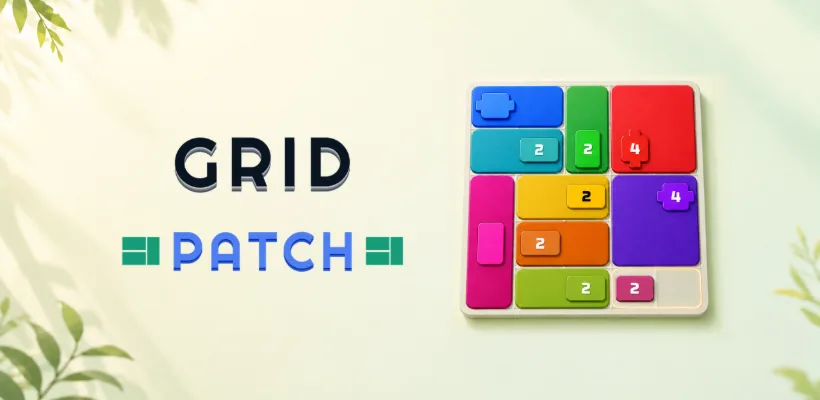
A calm rectangle puzzle with seven shape rules and 1,000 levels, each with exactly one answer, on Android phones and Meta Quest.
- Role
- Co-Founder
- Studio
- Vel Nest Games
- Platforms
- Android, Meta Quest
- Built with
- Unity, C#, UI Toolkit, OpenXR
- Levels
- 1,000, then endless
By the numbers
Draw rectangles until the grid is covered
Grid Patch is a calm logic puzzle about drawing rectangles. The board is a grid with a few clue cards on it. Each card shows a number, which is how many squares its rectangle must cover, and a small symbol for its shape. Drag from corner to corner to draw a patch around exactly one card, and keep going until every square is covered, with no gaps and no overlaps.
Every puzzle has exactly one answer, so you solve it by reasoning, never by guessing. There are no lives, no timer and no fail screen. A patch that does not fit simply does not stick. Grid Patch is free on Google Play, and on Meta Quest it is a paid, ad-free edition that needs no account and no internet.
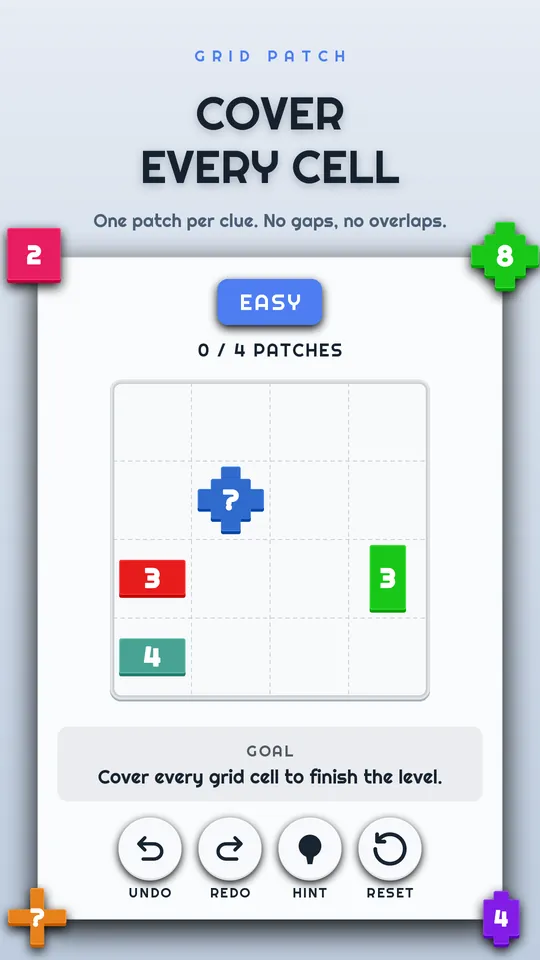
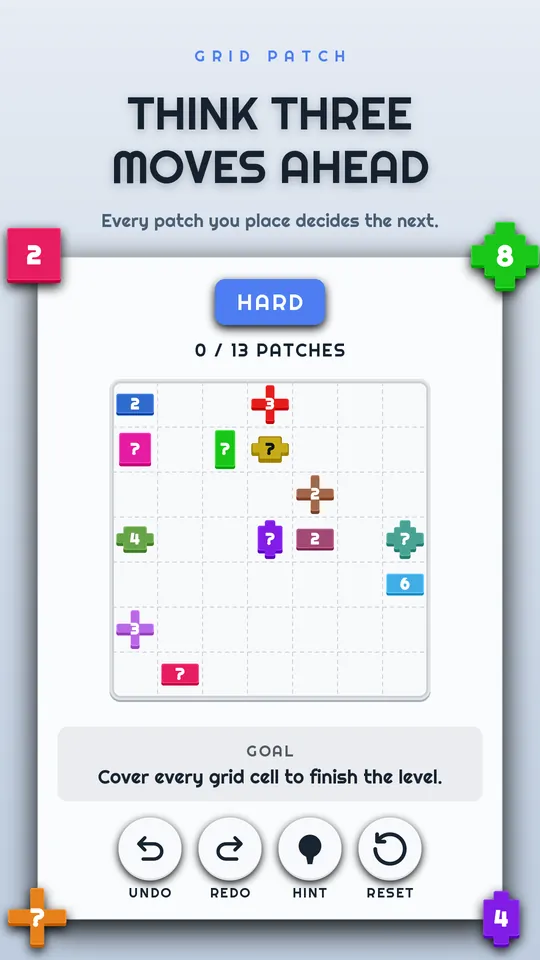
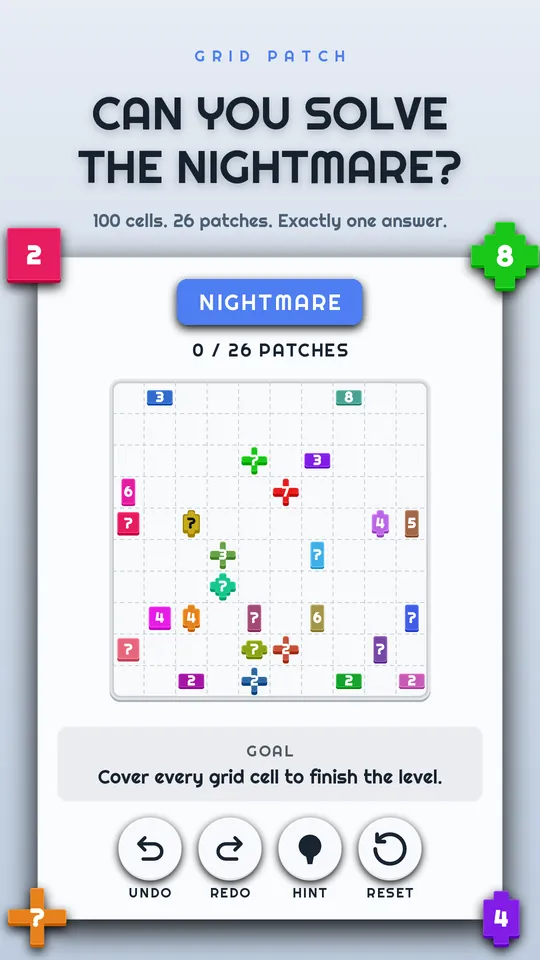
Seven shape rules on one grid
Grid Patch adds shape rules to the classic rectangle puzzle. A clue can ask for a wide patch, a tall one, a square, any rectangle, wide or square, tall or square, or wide or tall but never square. A "?" clue means any size from two up. A patch always covers at least two squares, because a one-square patch would add no decision.
When a number rules out part of a clue, the game quietly drops that part. A 3 can never be a square, so "tall or square" on a 3 simply means tall.
A thousand levels, each with one answer
The level builder works backwards. It splits the grid into rectangles, places one clue in each, and then proves the puzzle. An exact solver checks that there is only one answer and stops as soon as it finds a second. A second solver, based on published puzzle research, reasons like a person and counts the tempting wrong turns a player must see through. That count, not the board size, sets the difficulty tier, and small gaps between the tiers keep every level clearly inside one.
Every level must pass four checks: valid data, one answer, a human reasoning path inside its tier, and no copy of another level. Each accepted level is then generated a second time and must come out identical. One rebuild of 995 levels logged 573,807 attempts, and only 7 passed on the first try. After level 1,000 the game builds new levels on the device from the same rules, so it never runs out.
What players notice
- Difficulty is measured in wrong turns, never in board size, and the tiers arrive only once you have earned them.
- No lives, no timer, no fail screen. A patch that does not fit simply does not stick.
- On Meta Quest the board floats upright in front of you; draw with a controller or your bare hands.
- Every sound in the game was generated by code, down to the piano loop.
Teaching without a wall of text
The first twelve levels teach one rule at a time, with a silent hand that shows the move. Each button appears only when pressing it would do something: Hint first, then Undo and Redo, then the rest. Lessons accept every legal answer, not only the one the builder had in mind.
The drag preview takes on the clue's colour and firms up when the shape fits. It confirms the shape, never the answer. You can redraw across several patches in one move, and a single Undo brings the old layout back.
One game on phone and headset
The rules, the solvers and the level builder live once, in shared packages with no engine code. Two Unity projects build on top of them, one for Google Play and one for Meta Quest. Each release build opens its own package to prove it holds only what that store needs. The phone screens are built in code with UI Toolkit, and the light and dark themes switch instantly.
On Quest the board floats upright in front of you. Draw with a controller or pinch with your bare hands, and move, tilt or resize the board from a dock at its side. Choose light, dark or high contrast, and larger text. The game asks for the headset's fastest screen rate, and Quest 2 accepted 120 Hz. Every sound, down to the piano loop, is generated by code.
How I made it
As Co-Founder of Vel Nest Games, I designed the puzzle, its rules and what each difficulty should feel like, then played the levels until they felt right. An AI coding agent wrote most of the code, inside rules I set. Every change starts with a written plan of what it may touch, and every bug fix comes with a test that proves it. Comfort choices came from wearing the headset, like a level board by default and simpler move controls. In my words: "The code catches a broken level. I play the levels to catch a boring one."
What I used here
Game Feel & UX
Redraw several patches in one move, and a single undo brings the old layout back.
- The drag preview takes on the clue's colour and firms up when the shape fits.
- Undo appears after a first placement, and reset once the board has pieces on it.
- Tap, place, undo, error and win vibrations feel different, even on budget phones.
Level Design
Difficulty comes from tempting wrong choices, and every puzzle has exactly one solution.
- Each level must pass four checks: one solution, human logic, right difficulty, no duplicates.
- That check follows published puzzle research: it judges the deductions a player must notice.
- One rebuild of 995 levels logged 573,807 attempts. Only 7 passed on the first try.
UI Development
The whole phone UI is built in code, with light and dark themes that switch instantly.
- The tip area keeps its height, so the board never shifts under your finger.
- Every button was measured and enlarged until it was comfortable to tap.
- On Quest, players can choose light, dark or high contrast, plus larger text.
VR Interaction & Comfort
An upright board floats in front of you, with side controls to move, tilt and resize it.
- Recenter brings the board back to its usual spot in front of you.
- Saved positions are adjusted to keep the board fully in view.
- Play seated or standing, with controllers or your own hands.
Game Architecture
One codebase serves Google Play and Meta Quest, with the rules written once.
- The rules, solver and level builder run without the game engine, so tests are fast.
- Gameplay asks for a feeling, like 'success', and each device plays its own vibration.
- Each store build is checked to contain only what that store needs.
Performance
The release package shrank by 24% in the rebuild, with all 1,000 levels still inside.
- The frame rate matches the phone's screen, not a default 30 or 60.
- It opens in about a third of a second on a mid-range phone.
- On Quest 2 it asks for the headset's fastest screen rate, and Quest 2 accepted 120 Hz.
Testing & Quality
Two solvers and four checks run on every level; release builds open their own package to prove what is inside.
- A build step opens the finished Android app and stops the release if anything is missing.
- All 1,000 levels pass an automatic content audit.
- Checked on a real Samsung phone and a Quest 2 before release.
Tools & AI Workflow
Level Lab checks a level's logic and difficulty in one click, without starting the game.
- Campaign Builder drafts levels in batches and audits them before they ship.
- A Playtest window jumps straight to any level or save state.
- Before any change, the agent writes down how it will be proven.
Release & Publishing
I took it from first prototype to Google Play and Meta Quest, and updated both.
- Closed testing came first on Google Play, then full production.
- A Quest crash report was traced to its exact build and fixed in the next update.
- The store listing was built to Meta's exact image and video sizes.
End of the case studyThanks for reading.
More case studies
Working on something like this?
I'd love to hear about it. If there is a game or a project where this kind of work would help, send me a message.